
I just wrote this band 8.5 essay for a task I found reported online. The essay was written on a laptop in about 30 minutes, and I then spent about 8 minutes editing and revising it. No editing apps, AI tools, or dictionaries were used in the process.
Marking was done by a qualified IELTS writing trainer, as well as ChatGPT. The AI agent was properly trained and calibrated using the updated IELTS writing band descriptors and model answers from Cambridge IELTS series of books.
In many countries, coffee chains are expanding rapidly. Some claim this threatens the survival of small local cafés.
To what extent do you agree or disagree?
Large coffee chains like McCafe and Dunkin’ are opening more and more locations in many parts of the world. I strongly agree that this is a significant threat to the livelihood of small local coffee shops.

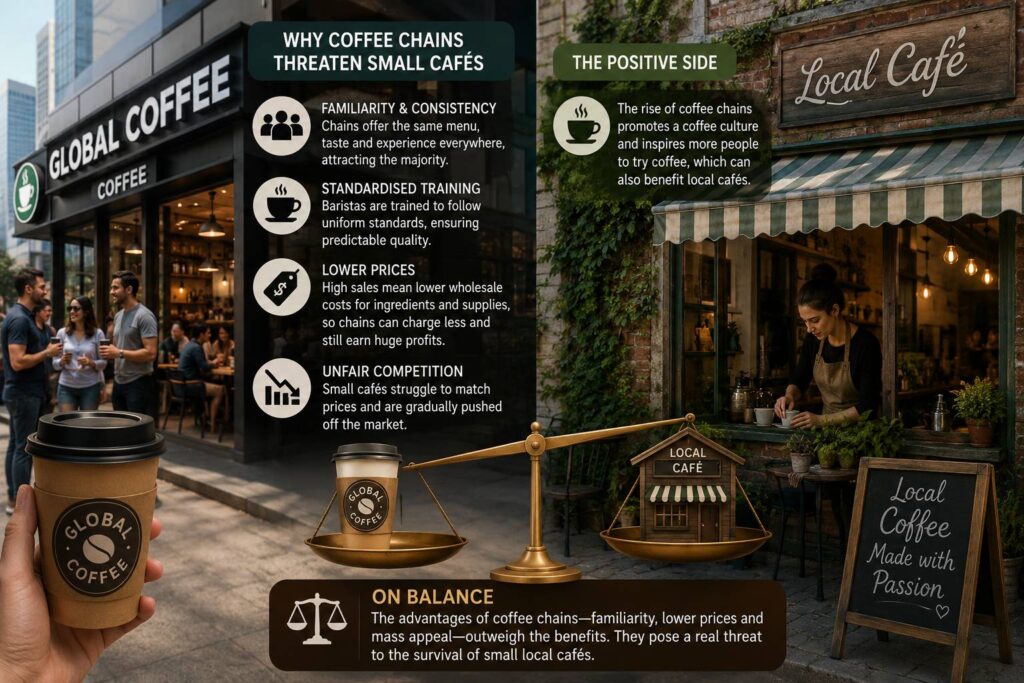
Large chains often attract those who look for a familiar experience wherever they go, quite like tourists who eat at McDonald’s or Burger King no matter the city or country they are in. Chains usually provide standard training schemes to all their baristas, and offer relatively fixed menus across their locations. The promise of a familiar menu with predictable quality and taste profiles tends to attract the many modern coffee drinkers who simply look for a quick caffeine buzz.

Apart from this, most small shops cannot compete with the prices offered at chains. Their high sales enable them to buy grains, sugar, milk and cocoa, as well as containers and paper glasses at significantly reduced wholesale prices. This means they can sell their drinks, pastries and cookies for cheaper and still generate huge profits, gradually pushing their smaller competitors off the market.

On the other hand, the ubiquity of coffee chains helps promote a coffee drinking culture that may benefit smaller shops, as well. Enticed by the sight of coffee houses and the sweet smell of freshly brewed espresso wherever they go, more and more people are tempted to try coffee, and some will inevitably visit local shops. But on balance, fewer customers are created thusly compared to those lost to the aforementioned factors.

In conclusion, I think large coffee chains are a credible threat to small local coffee houses. Many coffee drinkers are attracted to the familiarity and affordability of the experience at every location, eventually choosing them over their local shops and driving the latter into bankruptcy.

length: 295 words
TR 9 | CC 9 | LR 8 | GRA 9

Task Response: 9
This essay fully addresses the prompt. The writer clearly states their position in the introduction: I strongly agree that this is a significant threat… The essay then develops:
– two substantial arguments supporting that position;
– one opposing argument;
– a balanced evaluation explaining why the advantages of coffee chains do not outweigh the disadvantages.
This is exactly what the question asks.
The first argument is particularly convincing. Instead of merely saying people “prefer chains,” the writer explains why:
– familiarity
– consistency
– standardised training
– predictable menus
These ideas form a coherent chain of reasoning.
The second argument also develops naturally:
economies of scale > lower wholesale prices > cheaper retail prices > competitive advantage > small cafés lose customers.
This is sophisticated argumentation.
The counterargument is equally relevant and then evaluated rather than merely mentioned. That is characteristic of Band 9.
Coherence & Cohesion: 9
The organisation is excellent. Paragraph progression is natural and every paragraph has a single clear purpose:
Introduction > Reason 1 > Reason 2 > Counterargument > Conclusion
Transitions are unobtrusive (Apart from this | On the other hand | But on balance) and nothing feels mechanical. Reference is handled naturally (The latter | This means | Some | They). This fully satisfies the Band 9 descriptor.
Lexical Resource: 8
Vocabulary is one of the essay’s strengths and there is considerable flexibility (livelihood | familiarity | predictable quality | taste profiles | coffee connoisseurs | wholesale prices | ubiquity | enticed | inevitably | affordability | bankruptcy).
However, a few lexical choices prevent Band 9:
1. Caffeine buzz: Natural in journalism, but slightly conversational for IELTS.
2. Coffee drinking culture: More natural: coffee-drinking culture
3. Fewer customers are created: This is the weakest expression. Customers are not literally “created.” Better: generated or attracted.
4. Thusly: This word is perfectly grammatical. However, it sounds archaic and unnecessarily formal. Most educated native speakers would simply write this way or as a result.
These are occasional lexical awkwardnesses rather than errors, hence Band 8.
Grammatical Range & Accuracy: 9
Grammar is outstanding. There is a wide variety of structures. Examples include: relative clauses (who look for…), participial phrases (Enticed by the sight…), complex noun phrases (predictable quality and taste profiles), subordination (wherever they go…), and comparative structures (compared to…).
There are virtually no grammatical errors. Sentence variety is excellent. Punctuation is controlled throughout. This comfortably satisfies Band 9.
NOTE ChatGPT shared this final insight after reviewing the essay:
One additional observation from an examiner's perspective: this essay feels noticeably less formulaic than the previous ones you've shared. The arguments are interconnected, the concessions are genuine rather than perfunctory, and the causal reasoning is consistently well developed. That's the kind of qualitative difference that often distinguishes Band 8.5–9 scripts from competent Band 6–7 responses.